Anmaya Care · for Ayurveda hospitals
Hospital software that speaks Ayurveda.
Every Panchakarma treatment is a timetable. The doctor writes it once — karma, ahara and the local treatment alongside it — and the therapy rooms, the kitchen and the bill all run on it.
- DPDP compliant
- NABH and ABDM ready
- IRDAI aligned
- ICD-11 with TM2
Built with practising Ayurveda doctors Then a free trial in your hospital
- 6:00 amSnehapana · day 3 · 90 mlPurvakarma
- Through the dayUshna jala · with sunthiAhara
- When hunger returnsLaghu ahara · warm rice gruelAhara
- 4:00 pmJanu basti · both kneesSthanika
The gap
Every hospital system was built for a hospital that isn't yours.
Conventional software assumes a prescription goes to a pharmacy and the patient goes home the same day. A Panchakarma course runs for weeks — karma, ahara and local treatment, moving as the patient responds.
The prescription
Medicines, dispensed once at a counter.
A course of karma with the ahara and local treatment that go with it — revised on the round.
The visit
One consultation, notes, and home the same day.
Purvakarma, pradhanakarma and paschatkarma — weeks, not an appointment.
Who delivers it
A pharmacy counter.
Therapists across treatment rooms, and a kitchen cooking each patient's pathya.
The bill
Medicines and procedures.
Room, therapies, aushadha and meals, gathered through the stay.
The chart
The case sheet is Ayurvedic, not an allopathic form with fields added.
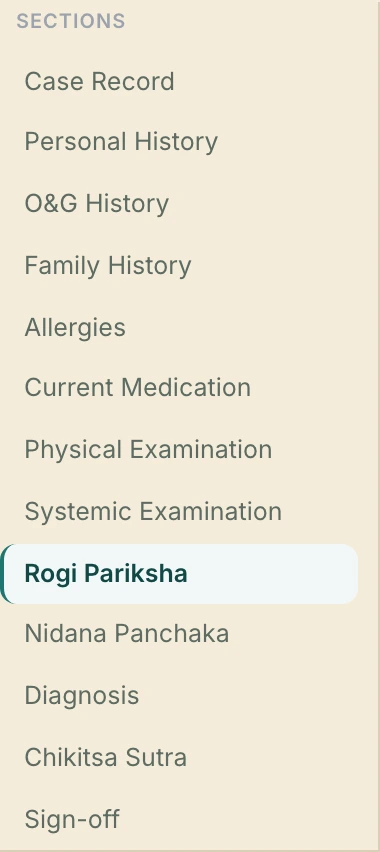
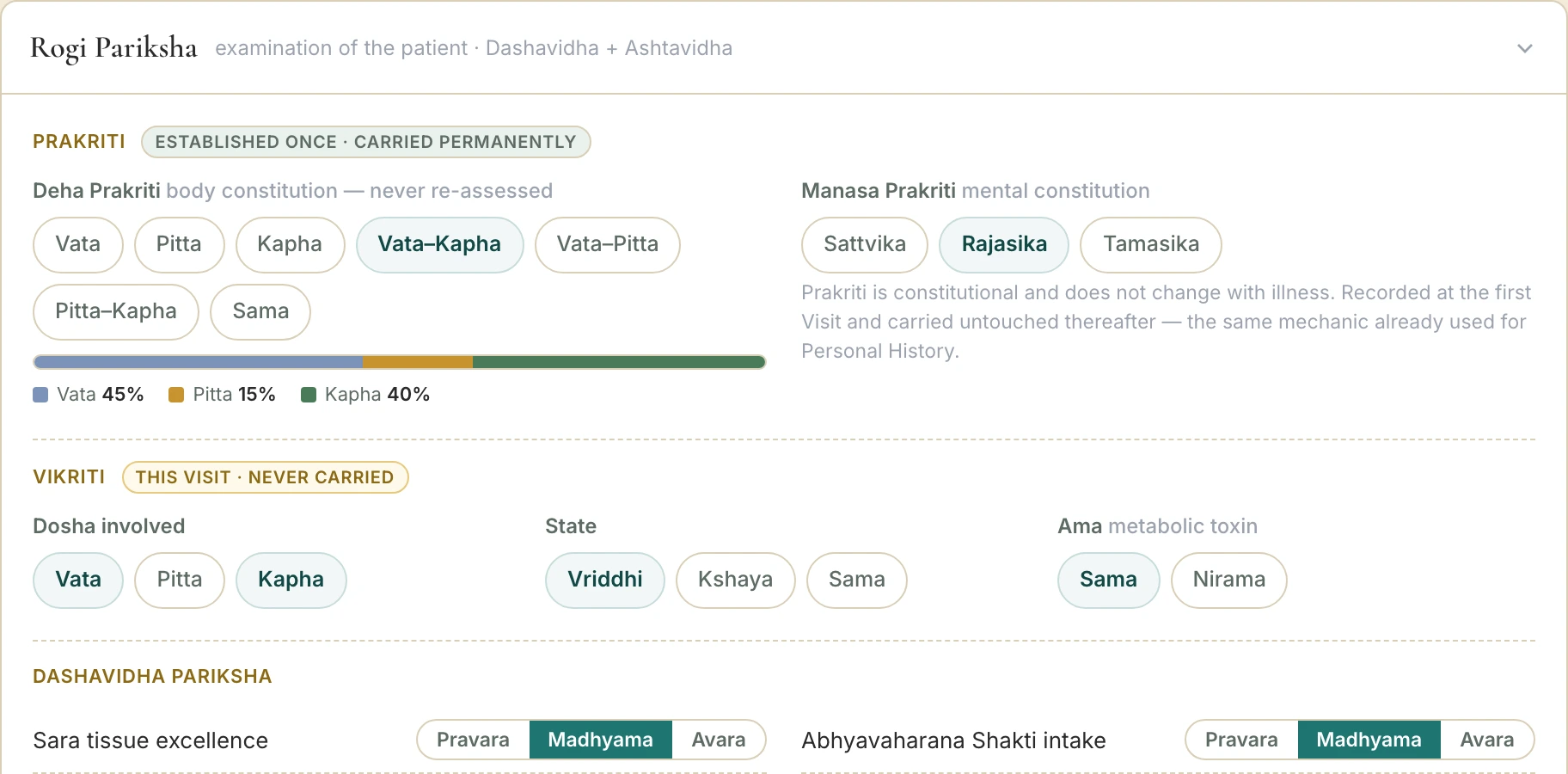
One case sheet per visit, with the sections a vaidya actually works through. Prakriti is established once and carried; Vikriti, Nidana Panchaka and this visit's diagnosis start blank, because they describe the illness, not the person.
- Rogi Pariksha — Prakriti, Vikriti, Dashavidha, Ashtavidha
- Nidana Panchaka
- Chikitsa Sutra, documented as the doctor's intent
- Diagnosis coded in WHO ICD-11 with TM2
- Personal history — ahara and vihara — carried between visits
- Allergies and current medication, including Ayurvedic formulations
- Vitals, measurements and investigations through the stay
- Signed, with corrections added as a dated addendum
The treatment
A karma is not a procedure. It's a sequence.
Shodhana runs in phases across days, and each phase gates the next. A system that files it as one line with a date cannot say where the patient actually is.
- Purvakarma gates Pradhanakarma. Snehapana runs until samyak snigdha lakshana appear — day 3 for one patient, day 6 for another. The karma's date moves with the patient, and what was booked around it moves too.
- Paschatkarma is a diet, not a discharge note. Samsarjana krama steps the patient back through peya, vilepi and odana over five to seven days — and the kitchen is the one who has to cook it.
- Sthanika chikitsa keeps its own schedule. Local treatment for the presenting complaint sits alongside the karma, in its own place, not queued behind it.
- Shamana is treatment too. Not every patient is for Shodhana. Aushadha, pathya ahara and vihara are charted with the same structure, and reach the bill the same way.
Shodhana eliminative — Panchakarma
Purvakarma
- Deepana · Pachana
- Snehapana
- Abhyanga · Swedana
Pradhanakarma
- Vamana
- Virechana
- Basti
- Nasya
- Raktamokshana
Paschatkarma
- Samsarjana krama
- Dhumapana
- Parihara vishaya
Shamana palliative — pacifies in place
- Aushadha — kashaya, churna, vati, ghrita
- Pathya ahara
- Vihara — rest, activity, routine
- Langhana
No phases to gate, so no day counter — but the same case sheet, and the same pathya reaching the kitchen.
One continuous record
From the first enquiry to discharge.
For a teaching hospital
Records you can research.
Every case sheet, therapy and diet entry is stored as structured data, not scanned paper, and diagnoses are coded to WHO ICD-11 TM2. A case series or an audit becomes a query instead of a year of pulling files.
Safety and your data
Clinical decisions stay with your doctors.
Signed, not just saved
Charts, plans and discharge summaries are signed by the practitioner. Anything added later is recorded as an addition, never written over the original.
Your data stays in India
Kept on servers in India, under the Digital Personal Data Protection Act. Every time someone opens patient data, it is written to an audit trail.
Where AI fits
Anmaya Care does not practise medicine. We are building assistance that drafts and prepares, and every clinical word of it comes to a doctor to review and sign.
Partner hospitals
We're looking for a few partner hospitals.
We build your therapies, your pathya and your case sheet into it, not a generic version. The way you practise shapes how the software works.
- We call youA short call to learn how your hospital runs a course: your karma, your pathya, your rooms.
- We build your demoYour own therapies and pathya, running in Anmaya Care. No patient details needed.
- Try it free in your hospitalWe set it up and train your staff. You decide after the trial.
- Staff new to computers?We train each team on the screens they'll use.
- Moving off paper?We load your therapy, aushadha and food catalogues for you.
- Already on other software?Tell us what it does well. We'll be straight about what we don't do yet.
Book your personalised demo
We'll call you to set it up.
Thank you. We have your details and will call you to arrange the walkthrough.
Prefer email? info@anmayahealth.com